Showing posts with label Arts. Show all posts

Tuesday, January 6, 2009

Some Thoughts on a Gute Reise


After school was over I had the opportunity to travel around (mostly) Northern Europe for a little while to meet new people and see new stuff. On the itinerary: Riga, Copenhagen, Stockholm, and Munich. Here’s a quick recap of the trip.


Riga


Riga is ice cold. If you travel there in December at three in the morning after attending a huge, free-alcohol, school-sponsored party, and then you walk around the city with wet feet gazing at the Baltic-gothic churches and architecture, you’re sure to get sick as a dog.


And so it was with me, wasting away much of my time in the fetal position in my bed in the hostel. Luckily, I was only guest staying in the hostel for the three days I was there, so others were spared my hacking, shivering, and whining. Plus, it was a fairly good environment in which to involuntarily spend time. The kitchen, all shiny and clean and advertised on HostelWorld as “the best kitchen in Riga,” was not a disappointment. Nor was the staff, who offered me biscuits and insider tips on the best pharmacies to visit in Riga.


Since I was the only one in the hostel, I took turns watching movies and television series with the complete rotation of workers. One pleasantly sarcastic Latvian girl --when the movie was paused, she would always say “hurry up, you’re missing it”-- and I watched about 8 hours straight of Dr. House. I told her through my sniffles and coughs that a medical drama/comedy was a good program for me to watch because at the end of the night I would have assimilated enough med-talk to be able to diagnose myself.


The one major thing that I DID have time to see in Riga was the Occupation Museum, which I found to be both sobering and inspirational. I also thought a more appropriate name for this museum would have been the Latvian National “Please Leave Us the Fuck Alone!” Museum.


Its purpose was basically to highlight the many downsides of hosting an occupying force in your country. For instance, I learned that the occupying guests almost always overstay their welcome: brutally suppressing any nationalist spirit or sign of criticism, sending dissenters to Gulag-esque labor camps, and almost never taking their shoes off at the border before coming into the country. Some guests.


In particular, the museum chronicled Latvia’s occupation first by the USSR around 1920, then by the Germans during WWII, and then again by the USSR until relatively recent times.


The highlight was looking at all the cool knick knacks and objects of art that the political prisoners made while imprisoned. Not just shivs and that sort of fare, but beautiful chessboards, furniture, and clothing.


Copenhagen


In Copenhagen I used Couchsurfing.com to find a couch to sleep on. It was kind of short notice, but luckily a woman named Linda was nice enough to take me into her house for a couple nights.


It was my first time using Couchsurfing, and I found it to be the height of cultural exchange.

The first night she made me a very traditional Danish Christmas meal (smeared black bread), played me some Danish pop music (Supine?) and laughed at my Danish pronunciation. And the next night I made American “Macaroni and Cheese,” played some blues on her piano, and marveled at her accent-free English. She was also kind enough to take some time out of her day and give me a walking tour of Copenhagen. That’s the big benefit of a site like couchsurfing, the personal connection with someone who knows the city and is willing to teach you about it. That’s tough to find at a hostel.

Plus, you might even meet other couch surfers in addition to your host. For instance, the second night a doctor from Tanzania named Wilson stayed with Linda and took the two of us out to a birthday party one of his Danish friends was having. Another great Danish experience.
A party, some new friends, a walking tour, and traditional food. Who could ask for more?

Stockholm


After Copenhagen it was on to Stockholm, where a friend of mine named Catia was staying for a couple of nights. This was great for a couple of reasons: 1) Catia is a good-souled and interesting human being and 2) when we hang out we speak exclusively in German.


Since I only had about week left to completely master ever single facet of the German language, and was currently still struggling with the difference between 17 and 70, a bit of practice was welcome.


Since neither of us are actual German masters (Catia is a native French speaker and I an English one) the results are somewhat hilarious. I’m sure for native German speakers it’s like listening to six-year olds blabber on. And that’s exactly what it’s like for us too. But that’s also the fun of it, the challenge of communicating. And armed only with smiles, a limited vocabulary, and childlike declarative sentences, we persevered and faced that challenge.


As far as sights and activities in Stockholm, we decided to go to the Nobel Prize museum. The national art museum might have been fun too, but we’d both seen Van Gogh sunflowers or Gauguin Polynesians before; the Nobel Museum, on the other hand, was something unique to Stockholm.


I still haven’t quite made up my mind about it. The museum was not only incredibly small, but it was also home to surprisingly few historical objects. A handful really. Some slippers from physicist X, a beaker from chemist Y, that sort of thing.


Luckily, there was a pretty cool temporary exhibit that took up about half the floor space of the museum. It dealt with how Ingmar Bergman (non-Nobel Laureate, but Swede, and one of Woody Allen’s idols) staged the productions of 5 Nobel prize-winning playwrights: Eugene O’Neil, Albert Camus, Luigi Pirandello, Harry Martinson, and a Swedish feller' named Par Lagerkvist. The exhibit was composed of, among other things, a bunch of great photos of Bergman in action by photographers who I’m sure are of great importance to people who know about that sort of thing.


Another highlight was the “Listening” section, where guests are invited to listen to acceptance or other speeches from past laureates. This was very cool.


There was a great little American section are where one could listen to post WWII American Nobel Laureates Ernest Hemingway, William Faulkner, and Toni Morrison. I had never heard Hemingway or Faulkner speak before. I was a bit surprised to hear Hemingway speaking almost exactly as he writes: in short, clear sentences (e.g.-- “My next book is about X. I hope it is good.”). I also very much enjoyed being exposed to Faulkner’s Southern twang and surprising modesty.


In contrast, I had heard Toni Morrison speak before. As always, I found her to be a very talented speaker with the odd gift that, as soon as she begins to speak ,the audience finds itself with the strange urge to begin weeping immediately for the pain and beauty of the human condition. It’s almost like a superpower. Admittedly, it’s not as cool a superpower as what Professor Xavier has, but probably cooler than whatever Jubilee does.


Munich


In Munich I stayed with another Couch Surfer named Florian who saved me from a hostel at the last moment. Florian gave me a little walking tour around the gates, churches, and squares of Munich and then I spent the rest of the day at the Pinakothek der Moderne (tons of Max Beckman and a great design and jewelry section). Later that night the two of us had a great dinner with 4 other couchsurfers (above) at a guy named Christian’s place.

That’s another one of the beauties of couchsurfing, the spontaneous hospitality. I wasn’t staying with Christian, but had met him at a couchsurfing meeting the previous night in Munich. After about two minutes of chatting he immediately invited me over for dinner the next night.

After dinner we drank Becks and red wine until well into the morning and eventually agreed on how to solve at least 30% of the world’s problems.

It was another great couchsurfing experience.

Amsterdam


Right now I am in Amsterdam for two days before heading home to the United States. My hostel is a bit dirty and the staff isn’t particularly friendly, but there’s wireless in my room and some interesting old hippies are here so I guess it’s a wash.

I’ll let you know how it goes. Then it’s back to Iowa. Hope to see you soon!

Friday, October 17, 2008

On the Birds and the Beasts


I seriously debated whether or not to post this shot. One the one hand, it seems kind of adolescent and, possibly, even a bit inappropriate for my more conservative readership (Hi Grandma!).


On the other hand. . .


I saw lions having sex at the zoo!


Spectators excitedly called to their friends, parents shielded the impressionable young eyes of their children, and cameras flashed paparazzi-style from all angles. It was incredible.


It was by far the coolest thing that I’ve ever seen at a zoo, and I’ve touched a tiger (Eric, vouch for me here).


Plus the photo turned out really, really good. Note the bite on the back (feral passion), the arched necked of the lioness (exquisite bliss), the intertwined tails (True Love). This shot has it all. Even the testicles seem to lend a certain gritty realism to the composition.


A masterpiece.

Wednesday, October 1, 2008

A Poet and Don't Even Know It


This article is awesome.

Hart Seely from Slate went through three Sarah Palin interviews, pulled a few statements verbatim from them, lumped them into stanzas and then called them poetry.

The concept seems pretty straight-forward, but the results are beautiful.

Keep in mind, this isn't just a cheap shot at Palin for not being the most informed or clear candidate. I think this same process could probably produce amazing results for any politician (or any person for that matter). But I do think that Sarah Palin has the ability to be a really prolific poet if she keeps at it.

Here is one of my favorites. Especially note the deft use of repetition in the first stanza and the intentional ambiguity of the last line.

Absolutely brilliant.


"Outside"

I am a Washington outsider.
I mean,
Look at where you are.
I'm a Washington outsider.

I do not have those allegiances
To the power brokers,
To the lobbyists.
We need someone like that.

(To C. Gibson, ABC News, Sept. 11, 2008)


Check out the article for more great hits like "On Good and Evil" and "Befoulers of the Verbiage."

Saturday, September 27, 2008

Reeperbahn Festival Day 1


I remember once reading an Onion headline that went something like this:

"Entire Town Secretly in Love with Lady who Works at the Coffee Shop."

That's one of the reasons why The Asteroids Galaxy Tour was my favorite act from last night. She's going to be a star.

Enjoy!


Wednesday, July 23, 2008

Sharing Funny Stuff

I was recently rewatching some of the hit web television series "Wainy Days," starring David Wain. I almost forgot how funny that show was. It's the kind of funny that you just want to share with the world.

Here are two of my favorite episodes. They only last about 5 minutes a piece. Enjoy.

(The episodes contain both adult language and situations, so if that kind of stuff doesn't interest you, please refrain).


Tuesday, June 3, 2008

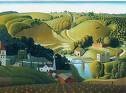
Why Diego Rivera is the Grant Wood of Mexico, or Vice Versa


As soon as I find someone who claims to have even passing knowledge of both Grant Wood and Diego Rivera, I’m going to make this bold statement: “You know, if you think about it, Grant Wood was really the Diego Rivera of the United States,” and see what comes out of it.


I will concede at the outset that this post will be written with the aid of hazily remembered facts and an imperfect understanding of the stylistic nuances of the visual arts (read: please don’t fact check this post). That being said, in quickly cobbling together the little that I know about the styles, eras, and politics of the two iconic painters, I think you’ll agree that the similarities are uncanny.

Where to start? Both were born in smallish, land-locked towns in the Western Hemisphere; Wood in Anamosa, IA and Rivera in Guanajuato, Guanajuato. Both began painting at a very early age and continued to study the arts through high school and college. Both went to Europe during the Impressionism craze and painted various impressionisty/cubistical looking pieces that hardly even resemble their more famous works. And for both Wood and Rivera, it was after being exposed to these colonial influences that both painters ended up finding their unique voices that, in many ways, were a reaction to and a rejection of these continental influences.

Rivera returned to Mexico and began to paint what he knew: the peasants, the indigenous peoples, farmers, laborers using bold, bright colors and simple figures. Wood returned, stepped out of his home near Iowa City, and began to paint scenes of farms and country folk performing everyday tasks using a similarly bright and bold color scheme on his canvasses, although usually with a tad more attention to detail.

And there’s more. They were also both ardent lefties. Rivera was an admirer of Emiliano Zapata, from whom the leftist Zapatista rebels (a group still active in the state of Chiapas) take their name, and a member of Mexico’s Communist party. Wood became close friend to Vice President and Iowan Henry A. Wallace, who ran unsuccessfully for President with the Progressive Party after being dropped by Roosevelt for being, get this, too liberal (and over-crazy). Wood even did Wallace’s portrait for a Time Magazine cover that appeared during his glory days. Both artists had successful academic careers teaching painting, Rivera at some University that I can’t remember, and Grant Wood at the University of Iowa.


Appropriate to their politics, both painters also played major roles in New Deal type policies. Rivera was chosen to lead various government funded mural projects when the government was looking to put people to work. Wood became the leader of several major public works art projects in the Midwest during the New Deal.

These appointments makes sense, as both men were proponents of murals as a more democratic form of art. Murals beautified cities and made art part of the landscape of one’s everyday world. They were also major projects and called for the work of many men to complete. Rivera has his murals at, among other places, the Palacio Nacional in Mexico City; Wood has his at, among other places, the Iowa State University Library.


Possibly the most striking similarities between the two mural-painting, revolutionary-loving, farmer-depicting lefties, was their philosophy about painting and art. Rivera revolted against all things colonial: customs, religion, class, cruelty, etc. Wood too revolted, but it was against a different kind of colonialism. He revolted against a blind acceptance of the artistic forms, subjects, and styles that had filtered from the cultural centers in Europe, through the East Coast of the States, eventually to be adopted by the heartland as not just fine art, but the finest art.

In his manifesto Revolution and the City, Wood called this kind of trickle down capacity for artistic creation or appreciation “Cultural Colonialism.” That’s right, the man wrote manifestos. And some critics refer to him and his work as quaint. Quaint people don’t spend sweaty nights pumping out manifestos. Wood took on the art establishment and he won. His victories might have been short lived, but they were on his terms. And at the time, this was revolutionary. To think, a painter in Iowa could step outside of his home, paint the land and his neighbors, and call it Art. The gall.


Of course, of the two, Rivera is viewed as the more revolutionary, probably because 1) he was a communist who participated in Communist revolutions; and 2) he was more overt in his critiques of religion, which always tends to get a rise out of the faithful. Case in point: one of the murals at the Palacio Nacional features a Priest with a bottle of liquor in one hand and a prostitute’s arse in the other. Then again, I still think there is a strong argument that American Gothic actually is a subtle critic on religion and conformity.


But let’s not stray to much from the thesis. When you get down to the heart of the matter, the two aren’t that different. They were both anti-colonialist skeptics who celebrated the simple beauty of the worlds that surrounded them. Revolutionaries both, through and through.

Viva Rivera! Viva Wood! Viva La Revolution!

Diego Rivera: 1886-1957
Grant Wood: 1892-1942

Saturday, April 26, 2008

End of the Year Law Book Reviews: From Violent Courtroom Thrillers to Rollicking Constitutional Laugh Fests


Book Review 1:


Criminal Law: Cases and Materials, Second Edition,

By Saltzburg, Diamond, Kinports, and Morawtez


Do you love page turning courtroom thrillers? How about seamy tales of the dark, criminal underbelly of society? If so Criminal Law: Cases and Materials, Second Edition, might be just what you’re looking for.

The beauty of Saltzburg’s latest work isn’t the sensational depictions of widespread sex and violence which keep you turning the pages; although that’s certainly one aspect. No, the beauty is that that the narrator tells these tales of violence, loss, and retribution so thoughtfully, with such depth, that we never lose sight of the moral dilemmas and philosophic underpinnings of the modern criminal justice system in which the characters operate. In that sense, reading Crimianl Law, Cases and Materials, Second Edition, is a bit like reading Crime and Punishment if Dostoevsky had written it while engaging in a late night drinking session Irvine Welsh and Johnie Cochran.

And while it’s true that the sensationalist, bloody nature of the substance kept me turning the pages, formally the work was a bit more challenging. Instead of a straightforward linear narration of the plot, Saltzburg presents the reader with vignettes in a very fragmented style.

One moment we are in 1923 witnessing a highly publicized bootlegging case. The next moment we are in 1983 for a nuclear protest case. Was the brother from trial 4 the same man who had a duty to act to save his wife in trial 92? Did the lawyer who prosecuted the gang member in trial 7 in 1962, become a judge, only to deliver a verdict for the subsequent gang member in 1992? What is the connection between these two events and what sort of relevance should we give to them?


Other questions jump out at the discerning reader. For example, what kind of significance should we give to the inclusion of a 20 page index at the end of the book? Should we take it at face value as a handy organizational tool? Or is it instead a tongue-in-cheek tribute to post-modern aesthetics? And what should we make of the studiously academic, almost clinical tone of the omniscient narrator?

In this sense, the book is much more Joyce than Grisham. And just as Joyce, its scale and scope are certainly daunting. But don’t let the size of the book, weighing in at 1002 pages, scare you off. Take it from me, Saltzburg has a gift for narrative economy, and easily packs more violence and contemplation into 1002 pages than most authors of the genre could pack into 1160. I’ll admit, it’s difficult for the reader to make sense of it all. God knows I tossed Gravity’s Rainbow against the wall 20 times before it all became clear. But stick with it, and remember, even if it doesn’t make sense, at least there’s a felony-murder scene just about every five minutes to make sure you keep turning those pages.

Book Review 2:


Constitutional Law, Sixteenth Edition

By Sullivan and Gunther


If you enjoyed the 1st through 15th editions, of Constituttional Law, be sure to pick up a copy of the sixteenth and you won't be disappointed.

It all starts out typically enough. The nation is in peril. Crime, racism and prejudice are rampant and plague every cranny of our society. The political divides are deep and the disparity of wealth is running out of control. Only one thing can stop a complete and total breakdown. . .

The confused, bumbling, and hilarious members of the United States Government.

Once the goofball legislators in Washington realize there’s a problem, they try to legislate it out of existence. But can they? Not if the Federal Judiciary has its way. The stern and humorless Supreme Court is in no mood for monkey business, and is ready to strike down any cockamamie congressional initiative it can get its judicious hands on.

Slapstick abounds as the legislators continue their futile attempts at lawmaking. A bill to protect civil rights? (Boing!) Unconstitutional! A bill for the enforcement of labor and environmental regulations? (Boing, Boing!). Not in our courtroom fellas.

And just when you think things can’t get any wackier, in comes the President. . . and he’s brought the states with him. The states are saying that they can fix these things on a local level, the President refuses to enforce what Congress has authorized him to do, and Congress is stripping the Court of its jurisdiction faster than the Court can invalidate its legislation. Pretty soon the entire cast of crazy constitutional characters is standing in a room seeing who can yell “Separation of Powers Doctrine” in their most grating voice.

Will Congress find a way around the unyielding, temperamental justices? Will the states hare-brained notions of sovereign immunity be honored? Will the President get to line-item veto that ill-advised spending provision? Or maybe, will this crazy cast set aside their differences, save a nation, and learn the value of teamwork along the way? I think that originalists and functionalists alike would agree. . .

Compact Federalism has never been crazier.

Book Review 3:

Civil Procedure, sixth edition

by Stephen C. Yeazell

This book is about Civil Procedure. That is all.

Friday, April 11, 2008

Tack on a Few More Pulitzers Linked to the Writer's Workshop


Seems like every year there are a few more.

Here's a link to the DI story.

Sunday, February 24, 2008

Making Link-Love with the UIMA


So, I just began using google analytics today, which is basically an online data collection tool that enables you to see which sites are linking to your site and what-not. Since my readership consists of about 10 people, all of whom are known to me, I never really figured it was worth my time.


But yesterday I decided to run it just to see how it worked and what kind of information it collected. I was very pleased to learn that, just in the last few days, one of the sites that linked to Cornucopia, The Horn of Plenty, was the University of Iowa Museum of Art Blog Art Matters. Apparently someone had stumbled across my post of the Robert Wilson Voom show at the Museum of Art and decided to link to it, along with two other blogs, in a quick post called "Web Chatter on Voom."

What's more, a fair number of people actually picked up on the link and came over to visit. Isn't that nice? Thanks for coming. Who knew that google analytics could tell you so much?

So, I figured I'd return the favor and send a little link-love to Art Matters so that those of you who are interested in a more comprehensive coverage of the Voom show or any other shows coming to the U of I can take a peak. It looks relatively new blog (their archives go to this past January), but they're already doing a good job of posting photos from events and keeping it updated frequently.

And if you still haven't gotten over to the show (this means you Em), you've got until March 30th, so set a date now.


Tuesday, February 12, 2008

American Gothic


It has come to my attention that I still haven't posted the photo of my Halloween costume from last year. I'd like to rectify that mistake right now. Above, you will find my beautiful girlfriend Emily and I giving our interpretation of the heartland classic, American Gothic. We're Gothic. We're American. It works.

Sunday, February 10, 2008

New York, Los Angeles, Moscow, Naples, and Iowa City


That's a list of the first 5 cities that get a peek at Robert Wilson's new video portrait show that's making the rounds. Apparently Robert Wilson did some work at the Univeristy a couple decades ago and he's always had a soft spot in his heart for us ever since. I went a couple days ago with my friend Jesse and we oohed and aahed and reflected and giggled the day away at the University of Iowa Art Museum. Above is the video portrait with Steve Buschemi.


The show consists of around 30 different celebrities, movie stars, dancers, animals, and non-celebrities posing for what appear to be still photos, but on closer examination are video portraits. You'll see Johnny Depp trying to keep his fingers absolutely still, and, for the most part succeeding, until a blink of the eye gives him away.


In some of the portraits, like the humorous, suspense filled take on Brad Pitt in is underwear, the movement is more prounounced. But in others, the only thing that keeps you from thinking that the shot is a still frame is the slow, shallow breathing of the subject, or a reflexive twitch of a muscle. It's almost like walking through one of those Scooby Doo castles where the eyes of the old portraits of barons begin to follow you around. In fact, the entire show, like Scooby Doo, or a haunted house, has a kind of faux-macabre feel to it. The premises are kept as dark as possible to intensify the brilliant colors of the portraits, and each time you take a blind turn you run into another creepy character (my favorite was the sad/bored talking black panther. What a beautiful, dangerous-looking animal). Of course, the cuts don't last forever, so it's always interesting to see how he's going to loop a 2 minute of 5 minute cut back onto itself.


The show is called the Voom series because all of the portraits are on crystal clear HD "Voom" television sets. Extremely impressive. My friend must have noted 3 times that it felt like you could reach in and touch the subjects. That's technology for you. What CAN'T it do.


So, if you're in the area I highly recommend checking out the show. In fact, give me a call and we can go together. I miss that beautiful talking black panther already.